


How can you tell if a Louis Vuitton bag is real?
Check a Louis Vuitton bag against the same model, material and production period. Its construction, canvas, stamps, hardware and lining should agree with that version. A date code helps you check the claimed age; it does not prove the bag is genuine. Authentication means assessing those details together, including anything that has been repaired or replaced.
Start with the model, not the logo.
Before you zoom into the logo, work out which bag you’re looking at. “Neverfull” describes a family of bags, not one unchanging design. A Monogram canvas MM and an Empreinte leather version share a name, but their materials and details need different references.
A neatly stamped logo can distract you from a pocket or handle attachment that belongs to a different version. Start with the whole bag, then examine the smaller details.
Look at where the stamp sits, how its patch is attached and the lining around it. Those details tell you more together than a crop of the lettering alone.
Use retail photographs to identify the model. Use the seller’s own photographs to examine the bag you would actually receive, including its wear and repairs.
Match the model, material and production period
The model, size, material and approximate age give you a starting point. M46987, for example, is a product reference identifying a version of the Neverfull. A date code describes production timing. Mixing them up can send you looking for the wrong bag.
For example, Louis Vuitton’s current Neverfull MM M46987 specification lists coated Monogram canvas, natural cowhide trim, striped textile lining, a hook closure and a removable zipped pouch. It also lists France, Spain or Italy as manufacturing locations for that reference. This is a reference for that version, not a specification for every Neverfull ever made.
For vintage and discontinued bags, a current product page is only a starting point. Earlier versions can have different linings, pockets or fittings. Establish the claimed age before treating an interior difference as a fault.
| Record | Why it changes the comparison |
|---|---|
| Model and size | Panel proportions, handles, pockets and hardware must be compared with the same version. |
| Material and colour | Printed canvas, embossed leather and coated leather have different surfaces and finishes. |
| Approximate production period | A current retail photograph does not document every earlier construction. |
| Repairs and replaced parts | Identify which parts are original before interpreting differences in colour, finish or stitching. |
Neverfull, Speedy or Alma: use the right reference.
The Monogram Neverfull MM reference below has a hook closure; the Alma BB has a double zipper and a structured base. On the Speedy Bandoulière, inspect the shoulder-strap attachments as well as the handles. These fixed parts help you check the seller’s model description before studying the lettering.
| Reference | Documented construction | Photograph these areas |
|---|---|---|
| Neverfull MM M46987 | Hook closure, side laces, striped textile lining and removable zipped pouch. | Full interior, pocket attachment, opening, side laces and handle bases. Photograph the pouch separately if included. |
| Speedy Bandoulière 25 M46977 | Monogram canvas, rolled handles, engraved padlock and detachable strap. | Both ends, zipper, handle attachments and the strap’s attachment points. Distinguish the Bandoulière version from a bag without a shoulder strap. |
| Alma BB M46990 | Double zipper, key bell, inside flat pocket and four protective base studs. | Base and studs, both zipper pulls, handle mounts, key bell and interior pocket. |
Manufacturer references: Neverfull MM, Speedy Bandoulière 25 and Alma BB. Specifications apply to these references, not every bag bearing the model name.
Hook closure, side laces and pocket layout. A missing detachable pouch is a different issue from an unexpected pocket construction.
Check the permanent mounts as well as the removable strap. A strap included in the sale does not make the bag a Bandoulière.
Compare the structured base, four studs and double zipper with the stated reference. Inspect wear separately from the placement of those parts.
Neverfull MM: the interior, closure and side laces
Monogram · Cerise lining · M46987
Inside this Neverfull, the fixed pocket sits against the back wall, the separate pouch hangs in front and the closure is above them. Their attachments reveal the layout far more clearly than a close-up of the red fabric alone.
Read the stamp with the pocket around it
In the interior view, the LOUIS VUITTON PARIS impression sits on the shaped leather tab beneath the fixed pocket’s zipper. Compare the tab’s outline, stitched edge and position as well as the text. This view locates the stamp; use a sharp, straight-on close-up to judge individual letter shapes.
Check what “pouch missing” means
The detachable pouch and the fixed inside pocket are separate parts. A listing without the pouch can still show the complete attached pocket. If that pocket is absent or rebuilt, ask about the version and any relining. Keep the Cerise interior shown here separate from other colourways and older Neverfull versions.
Speedy Bandoulière 25: follow the strap to the bag
Monogram · M46977
The shoulder-strap clip connects to a ring on the side leather strip. The handles have their own mounts above it. Following those two attachment routes helps you distinguish the construction of this Bandoulière from a bag simply pictured with a loose strap.
Separate the strap hardware from the handle hardware
The strap mount brings together a clip, ring, folded leather and securing stitches. The handle mount uses a rectangular fitting, rivet and pointed tab. If a fitting differs from the one shown, examine its attachment and ask whether it has been replaced.
Keep the stamp and the whole end of the bag in view
Keep the zipper-end tab in view when studying a Speedy stamp. Its shape and attachment help place the lettering on the bag; a tight crop removes that context. The Neverfull’s pocket stamp belongs to a different construction and is not a substitute reference.
Photographs: Louis Vuitton’s product galleries for Neverfull MM M46987 and Speedy Bandoulière 25 M46977. These views show the specified current versions.
What if the bag is missing its strap, pouch or padlock?
Preloved bags often lose their straps, pouches or padlocks. That changes what is included in the sale. A missing permanent attachment raises a different question about the model or a repair. An accessory bought separately needs its own assessment, even when the bag is genuine.
What if the exact version is discontinued?
Look for the original product reference and purchase year, then seek a reference showing that material and period. Save where the photographs came from. Another resale listing labelled “authentic” can help identify a name, but it cannot establish the construction you should expect.
Examine the canvas, stamps and hardware.
Work around the bag in order: canvas or leather, stamps, hardware, seams and interior. Keep the full-bag view beside the close-ups so you can place each detail on the item.
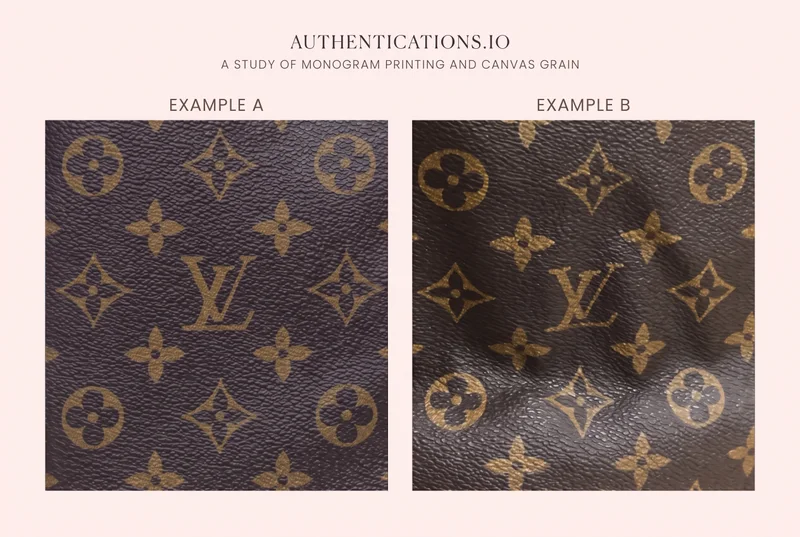
Canvas: the print, grain and panel layout
Start with the flower outlines and the spaces between them, then follow the pattern across the panel. Familiar LV initials can draw the eye away from a difference in motif proportions or placement.
Look at where the flowers meet the seams, trim and handle tabs. A cut motif is not automatically a fault. Check whether the seam and the print occupy the expected positions on that panel.
Warm indoor light can push brown canvas towards orange; glare can wash out the gold print. When shade is the only apparent mismatch, daylight photographs give you a fairer comparison.
The outline in A is narrower; B has broader gold areas around the centre. Compare those proportions across the repeated motifs, not just one isolated flower.
B also has stronger highlights and a different camera angle. Those differences affect the apparent texture and shade, so they cannot stand in for a matched material comparison.
How lighting can create a false mismatch
These two views use the same source image. Only the displayed colour and contrast differ. The warmer view makes the brown darker and the gold more orange; it does not show a different material or a different bag. If your comparison depends on colour alone, ask for daylight photographs before deciding the canvas is wrong.
 Original imageSame image · warmer colour
Monogram, Damier and leather need different checks
Damier’s squares make rows and seam placement easier to follow. Embossed leather presents a different surface: the depth and edges of the impression matter alongside the spacing of the motifs. An Empreinte bag needs a leather reference, not a canvas texture test.
On Damier, follow a row of squares from the middle of a panel towards its edges. Compare where that row meets the trim and handle attachments on the same version. A square cut at the edge is not enough to call the bag fake: you need to know whether the panel itself has the expected shape and seam placement.
For embossed leather, inspect both a broad area and the edge of an impression. Glare can hide shallow embossing; a close crop can hide the spacing between motifs. Neither is a substitute for checking the seams, pockets and fittings of that leather version.
Louis Vuitton heat stamps: lettering, spacing and depth
Read the heat stamp line by line: LOUIS VUITTON, PARIS, the registered mark and any country line. Look at letter height, the gaps between letters and the spacing between lines. Then inspect the edges of the impression and the leather around it.
What to look for in a real vs fake Louis Vuitton stamp
- The spacing in PARIS. Compare the gap after P with the remaining letters and with a documented stamp from the same model and period. An isolated gap deserves a closer look; read the word as a whole, including its position beneath LOUIS VUITTON.
- The shape of the S. Examine both curves, their width and the ends of the strokes. Compare the actual letterform with the matching reference. A perfectly symmetrical S is not a pass-or-fail rule.
- The impression in the leather. Look for distinct letter edges and check whether the surrounding grain remains visible. Read a weak impression or compressed edge alongside wear, leather texture and the rest of the stamp. Greater depth does not automatically mean genuine.
Even an unedited photograph can distort a stamp. A tilted camera stretches one side, while curved leather bends the apparent baseline. A straight-on view helps separate those effects from the lettering itself.
The comparison below isolates spacing on the PARIS line. Keeping the material, angle and light consistent makes the gap after the P easier to see. The stamp expected on your bag still depends on its model and period.
A keeps the PARIS line together; B separates the P from the remaining letters. Read each line independently rather than judging the stamp by its overall neatness.
After comparing the letters, inspect the patch shape, surface and stitching on the bag itself. Use the reference for its model and period; a spacing difference alone does not settle authenticity.
Hardware: inspect the part, engraving and attachment
On a clasp, inspect the hook’s outline, hinge, reverse and attachment before zooming into the engraving. On a rivet, check its position and the material it fastens. Correct lettering does not explain a fitting that differs from the reference.
Use the matching component for comparison: zipper pull against zipper pull, strap clasp against strap clasp. An isolated difference also makes repair history worth checking.
Bright reflections can hide the edges of an engraving, making it look much shallower than it is. A second angle in softer light often resolves that. Scraping plating or dismantling the fitting adds damage, not useful evidence.
The gap between LOUIS and VUITTON is visibly different in these examples. The clasp outline and joint above the engraving also deserve attention.
A is tilted and B is more face-on. Straight-on views make it easier to compare letter height and alignment without mistaking perspective for a manufacturing difference.
Zippers, padlocks and replaceable fittings
Compare the zipper pull, slider and attachment to the bag, not just the letters on the pull. Look at the reverse as well as the front. A replacement slider can explain an isolated difference, but that explanation needs to fit the repair history and the surrounding stitching.
A smooth zipper or heavy padlock can feel reassuring in the hand, but neither establishes who made the bag. Locks and straps can be swapped. Their permanent attachment points provide the connection to the item you are examining.
Look at the edges of the lettering
Match the same type of pull before comparing its lettering. A worn original, a replacement and a different production version can look different. A photograph cannot establish the metal’s composition or weight, so neither belongs in a verdict based only on this view.
Stitching, handles and lining
At a handle base, several construction details meet: the cut edge of the tab, its position, the thread and the route of the seam. That makes it more informative than a short stretch of stitching cropped away from the bag.
Stitch counts only help when they refer to the same model, size, attachment and production version. Repairs complicate the comparison: a changed seam or extra row of holes may record later work.
Inside, follow the lining from the opening down to the pocket. Compare the pocket’s shape, its attachment, the seams and any labels with the correct version. A close-up of fabric alone misses all four. Turn the pocket out only if it moves freely; forcing an old lining can tear it.
Compare the same section of a strap: the straight length, buckle end and folded attachment have different jobs. A buckle-end seam should not be judged against a riveted attachment at the opposite end. Follow any irregularity into the surrounding leather and check for repair work.
Repair or original construction?
Unused needle holes beside a seam can indicate earlier stitching. Follow them along the attachment and see whether the repair record describes work in that area. The holes alone cannot identify who did it.
Ask what was replaced, who did the work and whether the replacement came from Louis Vuitton. Those are separate questions from whether the bag itself is genuine. Match the invoice description to the repaired area; a document for a zipper repair does not explain replaced handles.
Vachetta, patina and wear
Louis Vuitton’s care guidance explains that natural leather darkens and that light-coloured canvas can suffer colour transfer. It also describes abrasion and fading on printed canvas at high-wear areas. These changes are reasons to assess condition separately from authenticity.
Pale handles on an older bag are a reason to ask about replacements, treatment and storage. The joins and stitching can help distinguish those explanations; a colour difference alone cannot.
Do not use water, alcohol or scratching as authenticity tests. They can damage the leather, coating or stamp you need to examine.
At least two human experts examine its details. You get the result and the findings behind it.
Real and fake Louis Vuitton bags: documented examples
These photographs come from the Museum at FIT’s Faking It exhibition. They show different models, not a matched pair. Photographs retain their original details; annotations are restyled for this guide.
Genuine Speedy 30: handle construction
2003 Murakami Speedy 30, accession 2010.56.2. Read the complete attachment; its stitch counts are not a rule for every Speedy.
An upside-down monogram on an authentic bag
The canvas wraps around the base, reversing the print on the back. This is a construction detail, not evidence of a fake.
Counterfeit Mini HL: check more than one seam
Circa 2005 Cerises Mini HL, accession 2014.13.1. One stitch count matches; others differ.
The wrong pocket and lining
The museum identifies an added zipped pocket and lining absent from the genuine Mini HL. That concerns this model, not every Louis Vuitton interior.
Does a Louis Vuitton date code prove authenticity?
No. A Louis Vuitton date code describes a production period and a factory convention; it is not a unique serial number for one bag. Counterfeiters can copy a plausible code. Reading it is useful, but it cannot authenticate the bag around it.
Use our free Louis Vuitton date code checker to read the production period, see how the digits work and compare the factory letters.
Keep a clear photo of the complete code and its location. A cropped or blurred character is easy to misread, especially after a messaging app has compressed the image.
| What you have | What to do next |
|---|---|
| A visible date code | Read every character, then check the date against the claimed model and production period. |
| No visible code | Check the claimed age, accessible pockets and tabs, and whether the lining has been replaced. An absent code alone does not establish a fake. |
| A phone scan or chip reading | Keep the reading, but do not treat a successful scan as proof of the bag’s authenticity. |
| A code that looks wrong | Check the photograph, characters and relevant era before drawing a conclusion. |
Many bags made after the 2021 transition have an embedded chip instead of a visible date code. Do not cut or unpick the lining to find it. A phone detecting a chip does not establish that Louis Vuitton made the bag, and a failed scan does not establish a fake.
How to read the digits
The same four digits can describe a month or a week, depending on the period. Choose the era first, then decode the marking using the table below.
| Period | How the date is represented |
|---|---|
| 1980s | Three or four digits: year first, then month. Later 1980s formats can include factory letters; do not apply the alternating-digit rule to these older codes. |
| 1990–2006 | In the four-digit portion, positions 1 and 3 give the month; 2 and 4 give the year. |
| 2007–early 2021 | Positions 1 and 3 give the week; 2 and 4 give the year. |
| After the 2021 transition | Many bags have an embedded chip instead of a visible date code. |
Check the calculation, not just the result
Take the four digits separately. Combine the first and third, then the second and fourth. The first pair you make is the month or week; the second is the year.
Here, combining digits 2 and 5 gives week 25, and combining 1 and 9 gives the year ending in 19. Reading the first two digits together would give the wrong week. Any letters before the digits are a separate part of the code.
For a month/year example, 1025 becomes 12 and 05: December 2005. You use the same alternating positions, but read a month rather than a week.
What do the letters mean?
The letters refer to a factory convention, not the owner, model or a unique bag number. Some codes were used in more than one country or period, so a two-letter prefix is not always a one-country answer. Keep them separate from the four date digits. Public lists can disagree or omit older codes, so a missing entry in a lookup is not enough to reject a bag. Check the original marking, country line and production period together.
When a date-code result does not make sense
- An impossible month: recheck the digits and whether the correct era was used. There cannot be a thirteenth month.
- A production date in the future: the calculation does not establish a plausible production date for the bag you have now. Check the era, characters and type of marking.
- A year before the claimed model existed: check the model identification and seller’s description. Do not change the interpretation just to make the listing fit.
- A country mismatch: ask for the full code and country marking in focus. Public factory-code lists are not manufacturer records and must not be treated as exhaustive.
- An ambiguous or unreadable character: keep it unresolved until you have a better photograph. Guessing a character can manufacture a plausible answer.
The date on a receipt is the purchase date. A bag made earlier can be sold later, so those dates don’t have to be identical.
Where to look, and when to stop
Look inside pockets, beside interior seams and behind leather tabs you can reach without forcing them. Take a wider photo of the location as well as the marking. Side lighting can make a faint impression easier to read.
Checks that can lead you to the wrong answer.
A valid code, a receipt and neat stitching can all appear alongside an unresolved problem. Use this table to work out what each observation actually tells you.
| What you notice | What to establish next |
|---|---|
| The date code matches | That establishes a plausible marking, not a genuine bag. Compare the stamp, materials and construction too. |
| The monogram is cut by a seam | Find the same panel on the same model. Check the seam placement before calling the interruption a fault. |
| One stamp looks wider | Compare straight-on images at the same scale. Perspective and curved leather can change the apparent proportions. |
| The handles are paler than the trim | Ask about replacements and treatment. Photograph the joins and stitching, not just the colour. |
| The bag smells unusual | Ask about storage and cleaning. Smell does not identify who manufactured the bag. |
| A phone detects a chip | A detection is not an authentication report. It does not examine the physical bag or establish its provenance. |
| The seller has a receipt | Check what connects the document to this item. A receipt photograph does not establish which bag will arrive. |
| Everything in the checklist looks right | You have not found an obvious inconsistency. That is different from establishing authenticity. |
See what our authentication service checks, which photos you need and what your result includes.
Which differences should make you stop and check?
A scuffed corner tells you about condition. A closure that does not belong to the claimed version raises a different question. Start with construction mismatches, then check whether repairs or poor photographs explain them.
| Difference | Why it matters | Next step |
|---|---|---|
| Construction does not match the claimed version | A different pocket, handle mount or closure is more specific than a vague concern about quality. | Confirm the reference, compare the same part on that version, and ask for repair records if it has been altered. |
| Several independent details disagree | A stamp discrepancy plus a different fitting and lining needs more explanation than one blurred letter. | Check whether each discrepancy remains in clear, matched-angle views. A plausible date code does not explain a different pocket or closure. |
| One replaced or repaired part | The changed component can explain an isolated difference, but it doesn’t answer questions about the rest of the bag. | Check repair records against the changed component, its attachment and the surrounding material. |
| Only colour or sharpness differs | Exposure, white balance and compression can change how a material or engraving appears. | Get a clear, comparable image before treating it as a physical mismatch. |
What about a very convincing replica?
A convincing replica can reproduce neat stitching, familiar lettering and a plausible date code. The harder question is whether those details belong together on that particular version of the bag.
Do not count matching details as a pass score. If the lining differs from the claimed reference, five convincing exterior details still leave that discrepancy unanswered.
When the seller says it has already been authenticated
Ask to see the result and the item photos attached to it. Match the bag’s wear, marks and fittings to the listing. If the report shows a different bag or doesn’t show enough to connect the two, it hasn’t answered your question about this purchase.
Get it authenticated before you pay, or show your buyer the result. Results in as little as 2 hours.
Which photos do you need for Louis Vuitton authentication?
These eight views let you connect close-up details to the whole bag. They are useful whether you are assessing a listing, documenting your own bag or arranging an authentication.
- Whole bagFront, back, sides and base.
- Logo & heat stampsBrand name and made-in lettering, sharply in focus.
- Interior & pocketsLining, pockets and all labels.
- Canvas or leatherA close-up of the texture, print and pattern.
- Hardware & strap claspsEngravings, rivets, buckles and both sides of clips.
- Zipper & stitchingZipper head, pull, seams and handle attachments, where present.
- Date codeEvery character and surrounding material, if present.
- Press-studsBoth open halves and their lettering, where present.
Put the bag on a table near a window. Tap the detail on your phone screen to focus, and keep direct flash off shiny hardware. Check that the lettering is readable at full size before moving to the next detail.
A photo request you can send the seller
Please send clear, unfiltered photos of this bag: front, back, both sides, base, full interior and pockets, brand and country stamps, handle attachments, stitching, zipper and hardware engravings, and the date code if it has one. Please include the strap, pouch and other accessories in the sale, and let me know about any repairs or replaced parts.
Check that the photos show the same bag
Open the original files at full size. Follow a distinctive crease, worn corner or stitch from the wider view into the close-up. If you cannot place the detail on the bag, ask for a wider view. Collages and compressed screenshots can hide the edges and lettering you need to compare.
Several photos of the front won’t fill a gap in the interior or hardware. Cover each area once clearly, then add angles where a detail is hidden.
What to do before you pay—and after it arrives.
Before paying, resolve missing photographs and unexplained alterations. Keep any earlier authentication report with its item images so you can connect the result to the listing.
- Save the listing, seller messages and photographs together.
- Ask about repairs, replaced parts and the bag’s purchase history.
- Read the marketplace’s payment, return and dispute terms before paying.
- Leave enough time to receive an authentication result before any purchase or return deadline.
If you’re selling, state the model, condition, repairs and included accessories clearly. If you have an authentication report, share its findings and item photographs so the buyer can connect it to your listing.
If the seller supplies only a receipt or certificate
A receipt records a transaction; the photographs show the item offered now. Ask for both. In an earlier authentication report, distinctive wear, marks and fittings help you establish whether it concerns the same bag.
Louis Vuitton guarantees authenticity for purchases through its listed official channels. That statement does not turn a photograph of a retail receipt into proof of what a resale seller will deliver.
If you have already received the bag
Photograph it before cleaning or altering anything. Compare its wear, marks and fittings with the seller’s photos, and use your own new photos for authentication. Save the listing and messages too. If you need to raise a dispute, check the marketplace’s deadline and required evidence immediately.
If two authentication results disagree
Start with the photographs each reviewer received. A blurred stamp and a sharp close-up can leave them working with different information. Ask which detail caused the disagreement, then address that detail with the missing view or repair record.
Louis Vuitton bag authentication: your questions.
Does an upside-down LV logo mean the bag is fake?
No. On a bag made with one continuous canvas panel, the print can turn upside down as it wraps underneath the base. Look at how that model is put together before judging the logo. An inverted motif and a badly aligned panel are different things.
Can a fake Louis Vuitton bag have a valid date code?
Yes. Counterfeiters can copy a code from a genuine bag. A date code tells you about the production period it represents; it doesn’t verify the bag carrying it. Read the date-code examples, then compare the lining, stamps and fittings with the version made in that period.
Which photos should I ask a Louis Vuitton seller for?
Ask for the front, back, base and interior, plus clear close-ups of the heat stamp, handle attachments, hardware and date code if present. Include any wear or repairs. The photo checklist gives you the full set, and there’s a message you can copy to the seller.
Does a missing date code mean my Louis Vuitton bag is fake?
No. Newer bags can have an embedded chip instead of a visible date code, while older markings can wear away or be difficult to reach. Bags predating the date-code system may have no code at all. First establish the model and approximate age. A missing code needs that context; it isn’t a reason to reject the bag on its own.
Can you tell if a Louis Vuitton bag is real from one photo?
One photograph can reveal a problem, but it cannot show everything needed to authenticate the bag. A convincing exterior says nothing about the interior stamp, pocket construction or hidden attachments. You need both whole-bag views and close-ups, rather than several photographs of the same side.
Should I authenticate my Louis Vuitton bag before selling it?
An authentication result gives your buyer something to review alongside the listing. Keep it with the photos of the exact bag you’re selling, and disclose repairs or replacement parts. If you’ve added a strap, pouch or padlock since the assessment, make clear whether that accessory was examined too.
Is Louis Vuitton Monogram canvas leather?
No. Classic Monogram canvas is coated canvas, often paired with leather handles and trim. The Neverfull MM shown in this guide is one example. Its body and handles are different materials, so they won’t feel or age the same way. Louis Vuitton also makes leather bags, including Epi and Monogram Empreinte designs.
Do Louis Vuitton bags have unique serial numbers?
The familiar Louis Vuitton date code is a production code, not a unique serial number. Two bags can carry the same code. That means a matching code on a listing, receipt or report cannot identify your individual bag; photographs of its wear, markings and construction matter too.
Can a Louis Vuitton bag made outside France be genuine?
Yes. Genuine Louis Vuitton bags are also made outside France. The current Alma BB reference linked in our model comparison, for example, lists the United States among its manufacturing countries. Check the country against the particular model and period, rather than treating “Made in France” as a requirement.
Can I authenticate a Louis Vuitton bag using the seller’s photos?
Yes, provided they show the necessary details clearly. Ask for photographs of the actual bag, including its interior and close-ups, rather than catalogue images. When it arrives, compare distinctive marks, wear and fittings with those photographs: an assessment of the pictured bag cannot establish what the seller will send.
Can a repaired or relined Louis Vuitton bag still be authentic?
Yes. Repairs don’t automatically make a genuine bag counterfeit, but replacement parts need to be identified. A new lining, handle or zip can explain a difference from the original specification. Keep repair paperwork and show both the altered areas and remaining original construction when the bag is assessed.
If my bag passes these checks, is it authentic?
Passing the familiar checks isn’t a complete authentication. A replica can have convincing lettering, a plausible date code and neatly sewn handles. The useful question is whether all those details belong together on that model and version. The decision section explains how to handle a detail that doesn’t fit.
Do a Louis Vuitton box and receipt prove the bag is genuine?
No. A genuine box can hold a counterfeit bag, and a receipt can belong to another purchase. Treat them as supporting documents, then check what actually connects them to the item being sold. The bag’s materials, markings and construction still need to stand up to examination.